You’ve done your research. You know tankless is the right choice. You’ve even picked a brand—maybe Navien, Rinnai, or Noritz. Now comes the decision that matters most: Who’s actually going to install it?
Here’s something most homeowners don’t realize: the installer matters more than the brand. A premium $3,000 Navien unit installed poorly will fail faster than a mid-range Rinnai installed by true tankless specialists. Installation quality determines 70% of your system’s long-term performance, safety, and lifespan.
As San Diego’s dedicated tankless specialists for over 20 years, we’ve seen the difference proper installation makes—and we’ve also seen the expensive mistakes homeowners face when they hire the wrong plumber. In this guide, we’ll walk you through exactly what separates a great tankless installer from an average one, so you can make a confident, informed decision.
Let’s get into it.
Quick Answer: What to Look For
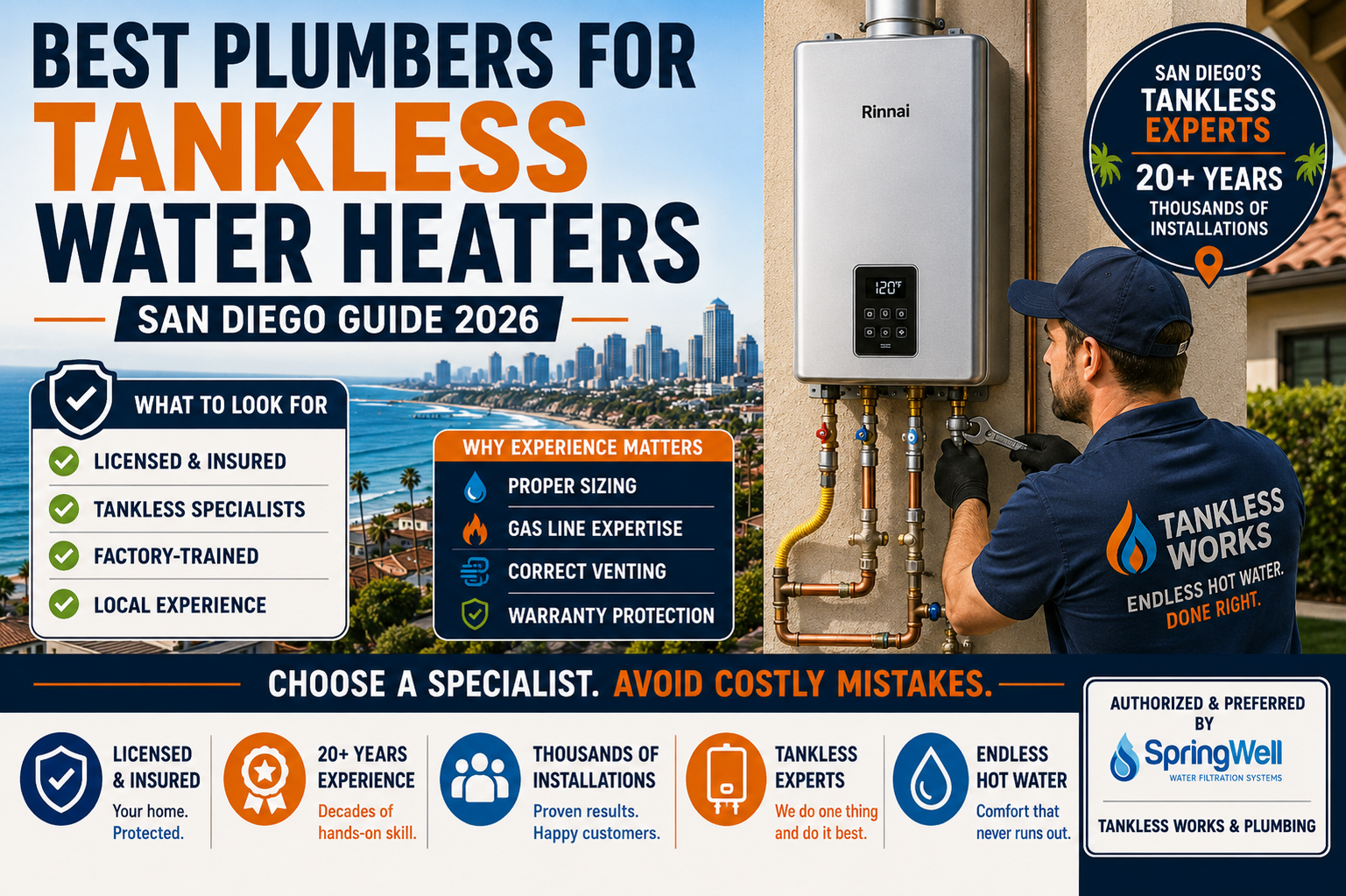
The 7 non-negotiables in a tankless installer:
- ✅ Tankless-specific experience (not just general plumbing)
- ✅ Proper licensing and insurance (C-36 Plumbing Contractor license in CA)
- ✅ Manufacturer certifications (Rinnai, Navien, Noritz training)
- ✅ Local San Diego experience (understands hard water, permits, codes)
- ✅ Transparent, written estimates (no hidden fees)
- ✅ Strong warranty backing (both manufacturer and labor)
- ✅ Verifiable reviews and references (real customer feedback)
Miss any of these, and you risk voided warranties, poor performance, or a system that fails years early.
Why the Installer Matters More Than You Think
The Hidden Cost of a Bad Installation
Tankless water heaters are precision equipment. Unlike traditional tanks (which are fairly forgiving), tankless systems require exact specifications to perform correctly.
What a poor installation costs you:
Undersized gas line:
- System can’t reach full capacity
- Constant strain on the unit
- Reduced lifespan (potentially by half)
- Poor hot water performance
Improper venting:
- Combustion problems
- Potential carbon monoxide risk
- Code violations (failed inspections)
- Heat damage to components
Incorrect sizing:
- Running out of hot water (undersized)
- Wasted money (oversized)
- Customer dissatisfaction either way
Poor water connections:
- Leaks developing over time
- Mineral buildup at connection points
- Water damage risk
Skipped permits:
- Voided insurance coverage if something goes wrong
- Problems when selling your home
- Potential fines
- No official inspection = unknown safety risks
The Real Numbers
Professional installation cost: $1,200-3,000 (labor + necessary upgrades)
Cost of fixing a bad installation: $2,000-5,000+ (often requires undoing bad work first)
Cost of premature system failure due to poor installation: $6,000-7,500 (full replacement, years early)
The math is clear: paying for quality installation upfront saves you money long-term.
The 7 Qualities of a Great Tankless Installer
1. Tankless-Specific Experience (Not Just General Plumbing)
Why this matters:
Many plumbers can install a traditional tank water heater—it’s relatively straightforward. Tankless systems are a different animal entirely, requiring:
- Gas line sizing calculations
- Venting expertise (different for condensing vs. non-condensing)
- Electrical knowledge (especially for electric tankless)
- Understanding of flow rates and BTU requirements
- Familiarity with error codes and diagnostics
What to ask:
- “How many tankless systems have you installed?”
- “What percentage of your business is tankless vs. traditional water heaters?”
- “Can you walk me through your typical installation process?”
Red flag: A plumber who says “sure, we can do that” without demonstrating specific tankless knowledge.
What we do differently: Tankless is literally in our name. We’ve completed thousands of tankless-specific installations—it’s not a side service, it’s our specialty.
2. Proper Licensing and Insurance
California requirements:
C-36 Plumbing Contractor License
- Required for any plumbing work in California
- Verify at: cslb.ca.gov
- Check for active status and any complaints/violations
General Liability Insurance
- Protects you if property damage occurs
- Should be at least $1-2 million coverage
Workers’ Compensation Insurance
- Protects you if a worker is injured on your property
- Required by California law for employees
What to ask:
- “Can I see your C-36 license number?”
- “Do you carry liability insurance? Can you provide proof?”
- “Are your installers employees or subcontractors?”
Red flag: Reluctance to share license information or “we’ll email it to you later” (should be readily available).
How to verify: Search the contractor’s license number directly on the California Contractors State License Board website before hiring anyone.
3. Manufacturer Certifications and Training
Why this matters:
Rinnai, Navien, and Noritz all offer professional training and certification programs. Certified installers:
- Understand brand-specific installation requirements
- Know how to properly commission the system
- Can diagnose brand-specific error codes
- Often provide extended warranty options (some manufacturers require certified installation for full warranty coverage)
What to ask:
- “Are you certified by [brand name]?”
- “What training have your installers completed?”
- “Does this affect my warranty coverage?”
Red flag: No specific training beyond general plumbing licensing.
Warranty impact: Some manufacturers offer extended warranties (or require certified installation for full warranty validity). Always confirm this before installation.
4. Local San Diego Experience
Why local expertise matters specifically:
Hard water knowledge: San Diego’s water hardness (7-17 GPG) requires specific installation and maintenance considerations. An installer unfamiliar with local water conditions might:
- Recommend the wrong brand for your area
- Skip discussing necessary maintenance
- Fail to mention water softener benefits
Permit and code knowledge: Different San Diego jurisdictions (City of San Diego, County unincorporated areas, individual municipalities) have varying permit requirements. Local experience means:
- Faster permit approval
- Correct code compliance the first time
- Fewer inspection delays
Seismic requirements: California-specific earthquake strapping requirements need proper implementation—something out-of-area contractors might not prioritize correctly.
What to ask:
- “How long have you served the San Diego area?”
- “What neighborhoods do you typically work in?”
- “How does San Diego’s water hardness affect your installation approach?”
Red flag: Vague answers about local conditions or inability to discuss San Diego-specific factors.
5. Transparent, Written Estimates
What a proper estimate includes:
✅ Itemized equipment costs (specific brand/model) ✅ Labor costs (clearly broken down) ✅ Necessary upgrades (gas line, electrical, venting) ✅ Permit fees (itemized separately) ✅ Timeline (installation date and duration) ✅ Warranty details (manufacturer + labor warranty terms) ✅ Payment terms (deposit, final payment structure)
What to watch for:
🚩 Vague, one-line estimates (“Tankless installation: $5,500”) 🚩 Cash-only demands or pressure for immediate payment 🚩 Estimates significantly lower than competitors (often means corners will be cut) 🚩 No mention of permits (red flag for code compliance) 🚩 High-pressure sales tactics (“This price is only good today!”)
What to ask:
- “Can you provide a detailed, written estimate?”
- “What happens if you discover additional issues during installation?”
- “Is this a fixed price, or could costs increase?”
Our approach: We provide itemized, written estimates before any work begins—you know exactly what you’re paying for, with no surprises.
6. Strong Warranty Backing
Two types of warranty to verify:
Manufacturer Warranty (Equipment):
- Heat exchanger: 12-25 years (varies by brand)
- Parts: 5-10 years typically
- Requires professional installation to remain valid
Labor Warranty (Installer):
- Should cover installation workmanship
- Typically 1-5 years depending on company
- Protects against installation errors
What to ask:
- “What labor warranty do you provide?”
- “If something goes wrong in year 2, who do I call?”
- “Does your installation maintain full manufacturer warranty?”
Red flag: No labor warranty, or unclear answers about what’s covered.
Why this matters: If your installer disappears (goes out of business, stops answering calls) and something fails, you’re stuck with expensive repairs even if manufacturer warranty technically covers it. Choose an established company with a track record.
7. Verifiable Reviews and References
Where to check:
- Google Business Profile (most reliable, verified reviews)
- Yelp (detailed reviews, photos)
- Better Business Bureau (complaint history)
- Nextdoor (neighborhood-specific recommendations)
- Direct references (ask for 2-3 recent customers to call)
What to look for in reviews:
✅ Specific details (not generic “great service!”) ✅ Response to negative reviews (how company handles complaints) ✅ Volume of reviews (established companies have many) ✅ Recent reviews (not just from years ago) ✅ Consistency (similar positive experiences across reviews)
Red flags in reviews:
🚩 Complaints about hidden fees or price increases 🚩 Mentions of no-shows or missed appointments 🚩 Comments about pushy sales tactics 🚩 Pattern of unresolved complaints 🚩 Very few reviews for an “established” company
What to ask:
- “Can you provide references from recent San Diego installations?”
- “Do you have reviews I can look at?”
Red Flags: Warning Signs of a Bad Tankless Installer
🚩 Major Red Flags (Walk Away)
No license or insurance verification available
- Absolute deal-breaker
- Puts your home and family at risk
Demands full payment upfront
- Legitimate contractors typically require deposit + final payment
- Full upfront payment is a common scam tactic
No physical business address
- Should have a real office or service area you can verify
- “Storm chasers” often lack permanent presence
Pressure tactics or “today only” pricing
- Legitimate businesses don’t need high-pressure sales
- Rushed decisions lead to regret
Unwillingness to pull permits
- “We can skip the permit to save money” is illegal and dangerous
- Voids insurance, creates safety risks, problems when selling home
⚠️ Moderate Red Flags (Proceed with Caution)
Significantly lower price than competitors
- Often means corners cut somewhere
- Could indicate unlicensed labor or inferior materials
Vague answers about specific brands
- Should have clear opinions and experience with major brands
- “We can install any brand” without specifics is concerning
No mention of San Diego-specific factors
- Hard water, seismic requirements, local codes
- Suggests lack of local expertise
Poor communication or slow response times
- If they’re slow before you’re a customer, expect worse after
- Communication issues often worsen post-installation
Questions to Ask Every Potential Installer
Use this checklist during your consultation:
Licensing & Insurance
- What’s your C-36 contractor license number?
- Can you provide proof of liability insurance?
- Do you carry workers’ compensation insurance?
Experience & Expertise
- How many tankless systems have you installed?
- What percentage of your business is tankless-specific?
- Are you certified by [brand you’re considering]?
- How long have you served San Diego specifically?
Process & Estimate
- Can you provide a detailed, written estimate?
- What’s included in the installation cost?
- Will you pull all necessary permits?
- What’s your typical installation timeline?
- How do you handle unexpected issues during installation?
Warranty & Support
- What labor warranty do you provide?
- Does your installation maintain full manufacturer warranty?
- What happens if something fails after installation?
- Do you offer maintenance services?
San Diego-Specific
- How does San Diego’s hard water affect your recommendations?
- Do you handle seismic strapping requirements?
- What San Diego neighborhoods do you typically serve?
References & Reviews
- Can you provide references from recent installations?
- Where can I see your reviews?
A quality installer will answer all these confidently and thoroughly. Hesitation or vague answers are warning signs.
What Makes Tankless Works Different
We’ve built our entire business around answering “yes” to every question above—confidently, with proof.
Our Credentials
✅ Fully licensed C-36 Plumbing Contractor (verify anytime at CSLB.ca.gov) ✅ Fully insured with comprehensive liability coverage ✅ 20+ years of San Diego plumbing experience ✅ Tankless specialists—not a side service, it’s literally our name ✅ Manufacturer certified for Rinnai, Navien, and Noritz installation ✅ Thousands of installations completed across San Diego County
Our Process
- Free, thorough consultation
- On-site assessment
- Accurate sizing calculation
- Infrastructure evaluation (gas, electrical, venting)
- Written, itemized estimate
- Transparent pricing
- No hidden fees
- Fixed pricing (not “estimate that grows”)
- Clear breakdown of every cost
- Professional installation
- One-day completion (typically)
- All permits handled by us
- Code-compliant work every time
- Proper testing and safety checks
- Ongoing support
- Homeowner training included
- Warranty registration handled
- Available for questions post-installation
- Annual maintenance program available
Why San Diego Homeowners Choose Us
Local expertise: We understand San Diego’s hard water, local permit requirements, seismic codes, and neighborhood-specific considerations because we’ve worked here for 20+ years.
Honest recommendations: We’ll tell you if a tank makes more sense for your situation, or which brand truly fits your needs—not just what earns us the most profit.
Complete accountability: When you work with us, you’re not dealing with subcontractors or a revolving door of technicians. Our team stands behind every installation.
The Interview Process: How to Compare Multiple Installers
Step 1: Get 3 Written Estimates
Never accept just one estimate. Compare at least 3 licensed, insured tankless specialists.
Step 2: Compare Apples to Apples
Make sure each estimate includes:
- Same brand/model (or equivalent)
- Same scope of work
- Same warranty terms
- All necessary upgrades included
Step 3: Verify Credentials
Before making a decision:
- Check CSLB license status
- Read recent reviews (last 6-12 months)
- Ask for 2-3 references
- Confirm insurance coverage
Step 4: Trust Your Instincts
Beyond the technical qualifications, consider:
- Did they answer your questions clearly?
- Did they explain the “why” behind recommendations?
- Did you feel pressured or informed?
- Would you feel comfortable having them in your home?
Step 5: Read the Fine Print
Before signing:
- Understand payment terms
- Know exactly what’s included
- Confirm warranty details in writing
- Understand the timeline
Common Mistakes Homeowners Make When Hiring
Mistake #1: Choosing Based on Price Alone
The cheapest estimate often means:
- Lower-quality materials
- Less experienced installers
- Corners cut on permits/code compliance
- Higher long-term costs (repairs, early replacement)
Mistake #2: Not Verifying Licensing
Anyone can claim to be licensed. Always verify independently through CSLB.ca.gov before hiring.
Mistake #3: Skipping the Consultation
Phone quotes without an in-person assessment often lead to inaccurate estimates and improper sizing.
Mistake #4: Not Asking About Permits
Some contractors skip permits to offer lower prices. This creates serious risks: voided insurance, code violations, and problems when selling your home.
Mistake #5: Ignoring Reviews
Take 15 minutes to read recent reviews. Patterns of complaints (hidden fees, no-shows, poor communication) are red flags worth heeding.
Mistake #6: Not Asking About Brand Certification
Manufacturer-certified installers often provide better warranty protection and understand brand-specific nuances.
Frequently Asked Questions
How much does professional tankless installation cost in San Diego?
Typically $1,200-3,000 for labor, plus $2,200-3,500 for equipment (brand-dependent), plus potential infrastructure upgrades ($800-2,500). Total installed cost usually ranges $5,000-7,500.
Should I get multiple estimates?
Yes, absolutely. Get at least 3 estimates from licensed, insured tankless specialists to compare pricing, approach, and communication style.
How do I verify a contractor’s license?
Visit cslb.ca.gov and search their license number or business name. This shows license status, any complaints, and disciplinary actions.
What if the cheapest quote seems too good to be true?
It probably is. Extremely low bids often mean unlicensed labor, skipped permits, inferior materials, or upselling once work begins.
Does the installer need manufacturer certification?
Not always required, but highly recommended. Certified installers understand brand-specific requirements and may provide access to extended warranties.
What permits are required for tankless installation in San Diego?
Typically gas line modification, plumbing, and sometimes electrical permits. A quality installer handles all permit applications and inspections.
How long should tankless installation take?
Most installations complete in one day (6-10 hours), assuming no major complications with infrastructure upgrades.
What questions reveal a bad installer quickly?
Vague answers about licensing, unwillingness to provide written estimates, pressure for immediate payment, or dismissiveness about permits are immediate red flags.
The Bottom Line
Choosing your tankless installer is the single most important decision in your tankless water heater journey.
The right installer:
- Protects your investment
- Ensures optimal performance
- Maintains warranty coverage
- Keeps your family safe
- Provides decades of reliable service
The wrong installer:
- Risks premature system failure
- Creates safety hazards
- Voids warranties
- Costs more in the long run
- Leads to frustration and regret
Take the time to properly vet your installer. Verify licensing, check reviews, ask detailed questions, and trust your instincts. A few extra hours of research can save you thousands of dollars and years of headaches.
Ready for Professional Tankless Installation?
We invite you to hold us to every standard outlined in this guide. Verify our license. Read our reviews. Ask us anything.
What you can expect from Tankless Works:
✅ Fully licensed and insured (C-36 #verify on request) ✅ 20+ years of San Diego tankless specialization ✅ Manufacturer-certified installers ✅ Transparent, written estimates ✅ Strong warranty backing ✅ Hundreds of verified reviews
We’re confident that once you compare us to other options, the choice will be clear.
Contact Tankless Works Today:
📞 Phone: (858) 220-4073
📧 Email: info@tanklessworks.com
🌐 Website: tanklessworks.com
Schedule Your Free, No-Pressure Consultation: We’ll assess your home, answer every question on this list, and provide a transparent written estimate.
Serving all of San Diego County:
La Jolla • Del Mar • Rancho Bernardo • Carmel Valley • Pacific Beach • Mission Valley • Scripps Ranch • Poway • Santee • Encinitas • Carlsbad • Escondido • Oceanside • and surrounding areas
Related Articles
- Best Tankless Water Heater Brands in 2026: Expert Comparison
- Tankless Water Heater Installation Cost in San Diego: Complete 2026 Guide
- Tankless Installation: What to Expect in San Diego
- How Much Money Does a Tankless Save? San Diego Analysis
- San Diego Hard Water: How It Affects Your Tankless Water Heater
About Tankless Works: San Diego’s premier tankless water heater specialists since 2004. Fully licensed, insured, and manufacturer-certified. We’ve completed thousands of installations across San Diego County and stand behind every one of them. Our commitment: Honest recommendations, transparent pricing, and installation quality that protects your investment for decades.